
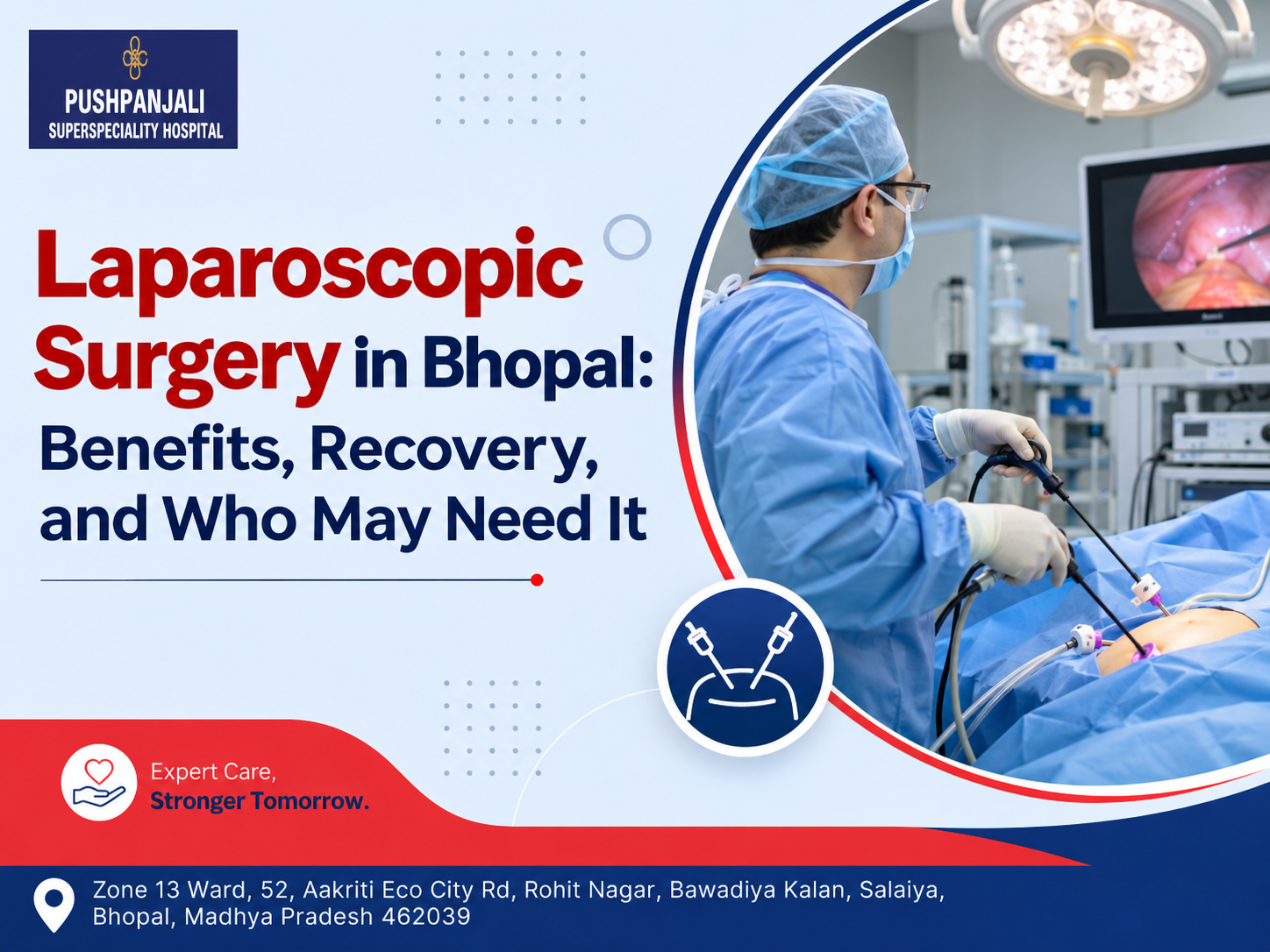
If you have been advised to undergo surgery for gallbladder stones, appendicitis, or a hernia, you may be considering laparoscopic surgery in Bhopal. Laparoscopic surgery, also called keyhole surgery, is a minimally invasive technique that uses small incisions, a camera, and specialised instruments to perform abdominal procedures.
Pushpanjali SuperSpeciality Hospital provides multispeciality care, including minimal-access surgery, for patients who may benefit from a minimally invasive approach. Choosing the best laparoscopic surgeon in Bhopal is important because the right surgical approach depends on your diagnosis, anatomy, and overall health. A qualified general surgeon in Bhopal can assess whether keyhole surgery in Bhopal is suitable for your condition.
Many people feel anxious when they hear the word “surgery.” However, laparoscopic surgery has become a common approach for many abdominal conditions because it may reduce surgical trauma compared with traditional open surgery. It does not mean that surgery is risk-free; rather, it means the surgeon may be able to achieve the treatment goal through smaller incisions and with less disturbance to surrounding tissues. This blog explains what laparoscopic surgery is, how it works, who may benefit, what recovery can look like, and when you should consult a general surgeon. It is intended for educational purposes and does not replace an in-person surgical consultation.
What Is Laparoscopic Surgery in Bhopal?
Laparoscopic surgery in Bhopal is a minimally invasive surgical technique used to treat conditions inside the abdomen and pelvis. It is also known as keyhole surgery in Bhopal because the surgeon makes a few small incisions instead of one large cut.
The surgeon inserts a laparoscope—a thin tube with a camera—through one of the small incisions. The camera sends a magnified image of the internal organs to a monitor, allowing the surgeon to see the surgical area clearly. Long, fine instruments are inserted through the other incisions to perform the required procedure. Depending on the condition, this may involve removing the gallbladder, appendix, or a hernia repair, or performing a diagnostic procedure to identify the cause of abdominal pain.
Laparoscopic surgery is also called minimally invasive surgery or minimal access surgery. The term “minimally invasive” refers to the surgical approach, not the seriousness of the condition. Some laparoscopic procedures are still major operations and require careful planning, anaesthesia, hospital care, and follow-up.
How Does Keyhole Surgery in Bhopal Work?
During laparoscopic surgery in Bhopal, a general surgeon in Bhopal makes small incisions and inserts a laparoscope—a thin camera—along with long, fine surgical instruments. The surgeon performs the procedure while viewing a magnified image on a monitor. Keyhole surgery in Bhopal may be used for diagnostic purposes as well as treatment, depending on the condition and surgical findings.
Steps in the procedure
- Assessment: The surgeon reviews your symptoms, medical history, blood tests, and imaging reports.
- Anaesthesia: The procedure is usually performed under general anaesthesia.
- Small incisions: The surgeon makes a few small incisions in the abdomen.
- Gas inflation: The abdomen may be inflated with carbon dioxide gas to create space and improve visibility.
- Camera insertion: The laparoscope is inserted to view the internal organs on a monitor.
- Surgical procedure: The surgeon performs the required repair, removal, or reconstruction using specialised instruments.
- Closure: The instruments are removed, the gas is released, and the incisions are closed with stitches, staples, or surgical glue.
The number and position of incisions depend on the procedure, the organ being treated, and the patient’s anatomy. After the procedure is complete, the surgeon closes the incisions and applies dressings.
Benefits of Laparoscopic Surgery in Bhopal
The main advantage of laparoscopic surgery in Bhopal is that it may involve less tissue disruption than open surgery. For suitable patients, this may mean less post-operative pain, smaller scars, a shorter hospital stay, and a quicker return to normal activities. The best laparoscopic surgeon in Bhopal can explain whether these benefits apply to your specific condition. Keyhole surgery in Bhopal is not suitable for every patient, and the surgeon may recommend open surgery in certain complex cases.
Potential benefits
- Smaller incisions: Laparoscopic surgery usually uses several small incisions rather than one large cut.
- Less post-operative pain: Many patients experience less pain after minimally invasive procedures, although pain levels vary.
- Reduced blood loss: Improved visualization and precise instruments may help reduce blood loss in suitable cases.
- Shorter hospital stay: Some patients may be able to go home earlier than after open surgery, depending on the procedure.
- Faster return to daily activities: Early mobilization and smaller incisions may support a quicker recovery.
- Better cosmetic outcome: Smaller scars may be less noticeable than a large open-surgery incision.
- Magnified view: The camera provides a magnified view of the surgical area, which can help the surgeon work precisely.
- Lower risk of wound infection: Smaller incisions may reduce the risk of wound-related complications in some cases.
These benefits are potential advantages, not guarantees. The actual outcome depends on the type of surgery, the complexity of the disease, the patient’s general health, and the experience of the surgical team.
Who May Need Laparoscopic Surgery in Bhopal?
You may be a candidate for laparoscopic surgery in Bhopal if you have a condition that requires surgical treatment and your anatomy, overall health, and diagnosis make a minimally invasive approach appropriate.
A general surgeon in Bhopal may recommend keyhole surgery in Bhopal for gallbladder stones, appendicitis, hernias, diagnostic laparoscopy, and selected other abdominal conditions.
You may need an assessment if you have
- Recurrent pain in the upper abdomen, especially after fatty meals.
- Known gallbladder stones or gallbladder inflammation.
- Severe pain in the right lower abdomen with fever, nausea, or vomiting.
- A bulge in the groin, abdomen, or near a previous surgical scar.
- A hernia that is painful, increasing in size, or causing discomfort.
- Unexplained abdominal pain that requires diagnostic evaluation.
- Obesity-related conditions that may require bariatric surgery.
- A condition that requires surgical removal or repair of abdominal organs.
Not every patient is suitable for laparoscopic surgery. Previous abdominal operations, extensive adhesions, severe obesity, complex anatomy, advanced disease, or certain medical conditions may make open surgery a safer option in some cases. A careful consultation is essential. Your general surgeon in Bhopal will review your symptoms, medical history, medicines, allergies, previous surgeries, and test reports before advising treatment.
Conditions Treated by a General Surgeon in Bhopal
Laparoscopic surgery in Bhopal may be used for gallbladder stones, appendicitis, hernias, diagnostic laparoscopy, and selected bariatric procedures. At Pushpanjali SuperSpeciality Hospital, patients can access surgical care supported by multispeciality services and emergency facilities. The best laparoscopic surgeon in Bhopal will assess your symptoms, scans, and medical history before recommending surgery. A general surgeon in Bhopal may also suggest medicines, lifestyle changes, or open surgery when appropriate.
Gallbladder stones
Gallbladder stones can cause pain in the upper right abdomen, especially after fatty meals. In some cases, they can lead to inflammation, infection, or blockage of the bile duct. Laparoscopic cholecystectomy is the standard surgical treatment for symptomatic gallbladder stones. It involves removing the gallbladder through small incisions.
Appendicitis
Appendicitis is inflammation of the appendix, usually causing pain in the right lower abdomen, fever, nausea, and vomiting. It often requires urgent surgical treatment.
Laparoscopic appendectomy is the preferred approach for many patients with appendicitis, including selected cases of perforation and peritonitis. It may reduce wound infection rates and hospital stay compared with open appendectomy.
Hernias
A hernia occurs when tissue or part of an organ pushes through a weak spot in the abdominal wall. Common types include inguinal, umbilical, incisional, and ventral hernias. Laparoscopic hernia repair may be used for selected hernias, often with mesh reinforcement to reduce the risk of recurrence.
Diagnostic laparoscopy
In some cases, laparoscopy may be used to diagnose unexplained abdominal pain, pelvic pain, or other conditions when imaging tests are inconclusive.
Bariatric surgery
Laparoscopic techniques may also be used for weight-loss surgery in selected patients with obesity-related health conditions. The decision depends on body mass index, associated diseases, and a full evaluation by a multidisciplinary team.
Laparoscopic Gallbladder Surgery in Bhopal
Laparoscopic surgery in Bhopal is commonly used for gallbladder stones and gallbladder inflammation. The procedure, called laparoscopic cholecystectomy, removes the gallbladder through small incisions.
Keyhole surgery in Bhopal may be recommended for recurrent pain, infection, or complications related to gallstones. A general surgeon in Bhopal will assess whether surgery is needed based on your symptoms and ultrasound findings.
When is gallbladder surgery needed?
Gallbladder surgery may be recommended when you have:
- Recurrent pain in the upper right abdomen.
- Pain after fatty meals.
- Gallbladder inflammation or infection.
- Gallstones causing blockage of the bile duct.
- Complications such as pancreatitis or cholangitis.
- Gallbladder polyps or other conditions requiring surgical removal.
Most people who undergo laparoscopic gallbladder removal have few or no complications. Many can go home the same day or the next day, and may return to normal activities within about a week.
Laparoscopic Hernia Surgery in Bhopal
Laparoscopic surgery in Bhopal may be used to repair inguinal, umbilical, incisional, and selected ventral hernias. The surgeon may use a mesh to reinforce the weakened area and reduce the risk of recurrence.
The best laparoscopic surgeon in Bhopal can explain whether keyhole surgery in Bhopal or open hernia repair is more suitable for your type of hernia.
When is hernia surgery needed?
Hernia surgery may be recommended when you have:
- A painful or increasing bulge in the groin or abdomen.
- Discomfort while coughing, lifting, or standing for long periods.
- A hernia that is growing in size.
- A hernia that is causing bowel obstruction symptoms.
- A hernia that is at risk of becoming strangulated.
Hernia repair may be done laparoscopically or through open surgery, depending on the type and size of the hernia, the patient’s anatomy, and the surgeon’s assessment.
Laparoscopic Appendix Surgery in Bhopal
Laparoscopic surgery in Bhopal may be used to treat appendicitis through a procedure called laparoscopic appendectomy. It involves removing the inflamed appendix through small incisions.
Keyhole surgery in Bhopal may be recommended for acute appendicitis, especially when early treatment is needed. A general surgeon in Bhopal will assess your symptoms, blood tests, and imaging before advising surgery.
When is appendix surgery needed?
Appendix surgery may be recommended when you have:
- Severe pain in the right lower abdomen.
- Fever, nausea, vomiting, or loss of appetite.
- Raised white blood cell count or infection markers.
- Imaging findings consistent with appendicitis.
- Signs of perforation or peritonitis.
Laparoscopic vs Open Surgery: Which Is Better?
Laparoscopic surgery and open surgery both have a role in abdominal surgery. The best option depends on the condition, anatomy, urgency, and patient factors.
| Factor | Laparoscopic surgery | Open surgery |
| Incisions | Several small incisions | One larger incision |
| Recovery | May be faster in suitable cases | May take longer |
| Pain | Often less after surgery, though it varies | May be more significant |
| Hospital stay | May be shorter for some procedures | May be longer |
| Scarring | Smaller scars | Larger scar |
| Suitability | Depends on condition and anatomy | May be needed for complex cases |
| Conversion risk | Small risk of conversion to open surgery | Not applicable |
Laparoscopic surgery is not automatically better than open surgery. In some situations, open surgery may be safer or more effective. The surgeon may convert from laparoscopic to open surgery if there is uncontrolled bleeding, dense adhesions, poor visibility, or an unexpected anatomical problem.
Conversion should not be viewed as a failure. It is sometimes the safest decision to protect the patient and complete the operation properly.
Recovery After Laparoscopic Surgery in Bhopal
Recovery after laparoscopic surgery in Bhopal depends on the type of procedure, your overall health, and whether any complications occur. Many patients can walk, eat, and return home within 24–48 hours after uncomplicated gallbladder or appendix surgery.
At Pushpanjali SuperSpeciality Hospital, post-operative care may include pain management, wound care, early mobilisation, dietary guidance, and follow-up visits. The best laparoscopic surgeon in Bhopal will advise you on wound care, diet, activity restrictions, and follow-up visits. Keyhole surgery in Bhopal may allow a faster return to work and daily activities compared with open surgery in suitable cases.
First 24–48 hours
After surgery, you may feel tired, sore, or bloated because of the gas used during the procedure. Shoulder-tip discomfort can also occur after laparoscopic surgery due to irritation from the gas, but it usually improves within a day or two.
You may be advised to:
- Walk gently and frequently to support circulation.
- Eat light, easily digestible meals.
- Avoid heavy lifting or strenuous activity.
- Take prescribed pain relief and antibiotics if advised.
- Keep the incisions clean and dry.
- Attend follow-up appointments as scheduled.
First week
Many patients can return to normal activities within a week after laparoscopic gallbladder removal or appendectomy, although this varies with the procedure and individual recovery.
Avoid lifting heavy weights, driving before you are medically cleared, and doing intense exercise until your surgeon advises. Follow the medication schedule exactly, including pain relief and any antibiotics prescribed after surgery.
Weeks 2–4
Most patients can return to most normal activities within one to two weeks after some laparoscopic procedures, although this varies with the type of surgery and individual recovery.
Avoid heavy lifting, strenuous exercise, swimming, or sexual activity until your surgeon confirms that it is safe. Attend all follow-up appointments, especially if you have a drain or stitches.
When to seek urgent help
Contact your surgical team or seek emergency care if you develop:
- Fever or chills.
- Worsening abdominal pain or swelling.
- Heavy bleeding from the incision.
- Persistent vomiting or inability to pass urine.
- Shortness of breath or chest pain.
- New weakness, fainting, or confusion.
- Redness, discharge, or increasing pain around the incision.
Is Laparoscopic Surgery in Bhopal Safe?
Laparoscopic surgery in Bhopal is generally safe when performed by an experienced surgical team in an appropriate hospital setting. However, like any surgery, it carries risks including bleeding, infection, anaesthesia-related complications, injury to nearby organs, and sometimes conversion to open surgery if required.
A general surgeon in Bhopal will explain the benefits, risks, alternatives, and expected recovery before obtaining your consent. Keyhole surgery in Bhopal requires careful assessment and appropriate hospital infrastructure.
Possible risks
Common temporary effects may include:
- Pain or soreness around the incisions.
- Shoulder-tip pain from the gas used during surgery.
- Nausea or bloating.
- Temporary fatigue.
- Small wound-related issues.
Less common but important risks may include:
- Bleeding requiring transfusion or further treatment.
- Infection.
- Injury to the bowel, spleen, liver, pancreas, lung, or blood vessels.
- Bile duct injury during gallbladder surgery.
- Hernia at an incision site.
- Blood clots in the legs or lungs.
- Need for conversion to open surgery.
- Anaesthesia-related complications.
A review of laparoscopic procedures reported that complications can include wound infection, hernia at the port site, and organ injury, although serious complications are uncommon when appropriate safety protocols are followed.
How to Choose the Best Laparoscopic Surgeon in Bhopal
When choosing the best laparoscopic surgeon in Bhopal, look for a clinician who explains the diagnosis clearly, discusses both surgical and non-surgical options, and has experience with the specific procedure you may need.
A general surgeon in Bhopal should also explain the expected recovery, possible risks, hospital stay, follow-up plan, and cost estimate. Pushpanjali SuperSpeciality Hospital offers multispeciality support, emergency care, and advanced facilities for patients considering laparoscopic surgery in Bhopal.
Questions to ask your surgeon
- What is the exact diagnosis, and what tests confirm it?
- Do I need surgery now, or can the condition be monitored or treated another way?
- Am I a suitable candidate for laparoscopic surgery?
- What procedure will be performed, and what are the expected benefits?
- What are the possible risks and complications?
- What happens if the surgery needs to be converted to open surgery?
- How long will I stay in hospital?
- When can I return to work, exercise, and normal activities?
- Will I need a drain, catheter, or stent?
- What follow-up tests will I need after surgery?
- What will the approximate cost and insurance coverage be?
A good surgeon will not pressure you into surgery. They will explain the reason for treatment, the alternatives, and the risks in language you can understand.
Laparoscopic Surgery in Bhopal: Frequently Asked Questions
1 What is laparoscopic surgery in Bhopal?
Laparoscopic surgery in Bhopal is a minimally invasive procedure that uses small incisions and a camera to treat conditions inside the abdomen. It is also called keyhole surgery in Bhopal.
2 Who is a candidate for laparoscopic surgery in Bhopal?
A general surgeon in Bhopal may recommend laparoscopic surgery in Bhopal for gallbladder stones, appendicitis, hernias, diagnostic laparoscopy, and selected other abdominal conditions. Candidacy depends on your diagnosis, imaging, and overall health.
3 Is laparoscopic surgery painful?
You may experience some discomfort after surgery, but many patients have less post-operative pain compared with open surgery. The best laparoscopic surgeon in Bhopal will provide a pain-management and recovery plan.
4 How long is recovery after laparoscopic surgery in Bhopal?
Recovery depends on the procedure and your overall health. Many patients return home within 24–48 hours after uncomplicated gallbladder or appendix surgery.
5 Is laparoscopic surgery safe?
It is generally safe when performed by an experienced surgical team, but all surgery carries some risk. A general surgeon in Bhopal will discuss the possible benefits, risks, alternatives, and need for conversion to open surgery if necessary.
6 How do I choose the best laparoscopic surgeon in Bhopal?
Look for a qualified best laparoscopic surgeon in Bhopal who performs a full assessment, explains risks and benefits, uses appropriate hospital infrastructure, and includes clear follow-up care.
7 Can gallbladder stones be removed with laparoscopic surgery?
Yes. Laparoscopic cholecystectomy is the standard surgical treatment for symptomatic gallbladder stones and gallbladder inflammation.
8 Can hernia be repaired with laparoscopic surgery?
Yes. Laparoscopic hernia repair may be used for selected inguinal, umbilical, incisional, and ventral hernias, often with mesh reinforcement.
9 When is open surgery needed?
Open surgery may be preferred when anatomy is complex, disease is extensive, bleeding cannot be controlled laparoscopically, or the surgeon needs better access to the affected area. The decision is made in the patient’s best interest.
10 Where can I get laparoscopic surgery in Bhopal?
You can consult a qualified general surgeon in Bhopal at Pushpanjali SuperSpeciality Hospital for assessment and treatment of gallbladder stones, appendicitis, hernias, and other abdominal conditions. The hospital offers multispeciality care and emergency support.
Final Thoughts – Laparoscopic surgery in Bhopal
Laparoscopic surgery in Bhopal may offer a minimally invasive option for selected gallbladder, appendix, hernia, and diagnostic procedures. The right treatment depends on an accurate diagnosis, imaging findings, overall health, and the experience of the treating team.
If you are looking for the best laparoscopic surgeon in Bhopal, book a consultation with a qualified general surgeon in Bhopal to understand whether keyhole surgery in Bhopal is suitable for your condition.
Laparoscopic surgery is not a one-size-fits-all treatment. Some conditions can be managed with medicines, lifestyle changes, or non-surgical procedures, while others require surgical intervention. The goal is always to choose the safest and most effective option for the individual patient.